When your neck stays knotted, your back tightens after yard work, or your calves cramp in the middle of a run, your muscles may be short on the mineral that helps them relax. Here is how we use magnesium oil with our own patients, and why it works.

Make a fist and squeeze it as hard as you can for ten seconds, then open your hand. Letting go feels like nothing at all, but inside every muscle fiber it actually takes work. Relaxing a muscle runs on a mineral that most of us lose faster than we put it back.
That mineral is magnesium. Calcium is the signal that tells a muscle fiber to tighten, and magnesium is a big part of what lets it relax again. When the two get out of balance, the muscle is slower to let go and the nerve that controls it is quicker to fire. In our Mauldin office, that looks like shoulders that never come down, a back that stays tight all week, glutes that ache after a long drive, and calves that cramp halfway through a run.
We already wrote a guide on using topical magnesium oil for sleep, for those 3 a.m. wake-ups. This guide is about your muscles during the day: the tension that won’t let go, the cramps that catch you mid-stride, and the tightness that builds up after you train, lift, or sit for too long.
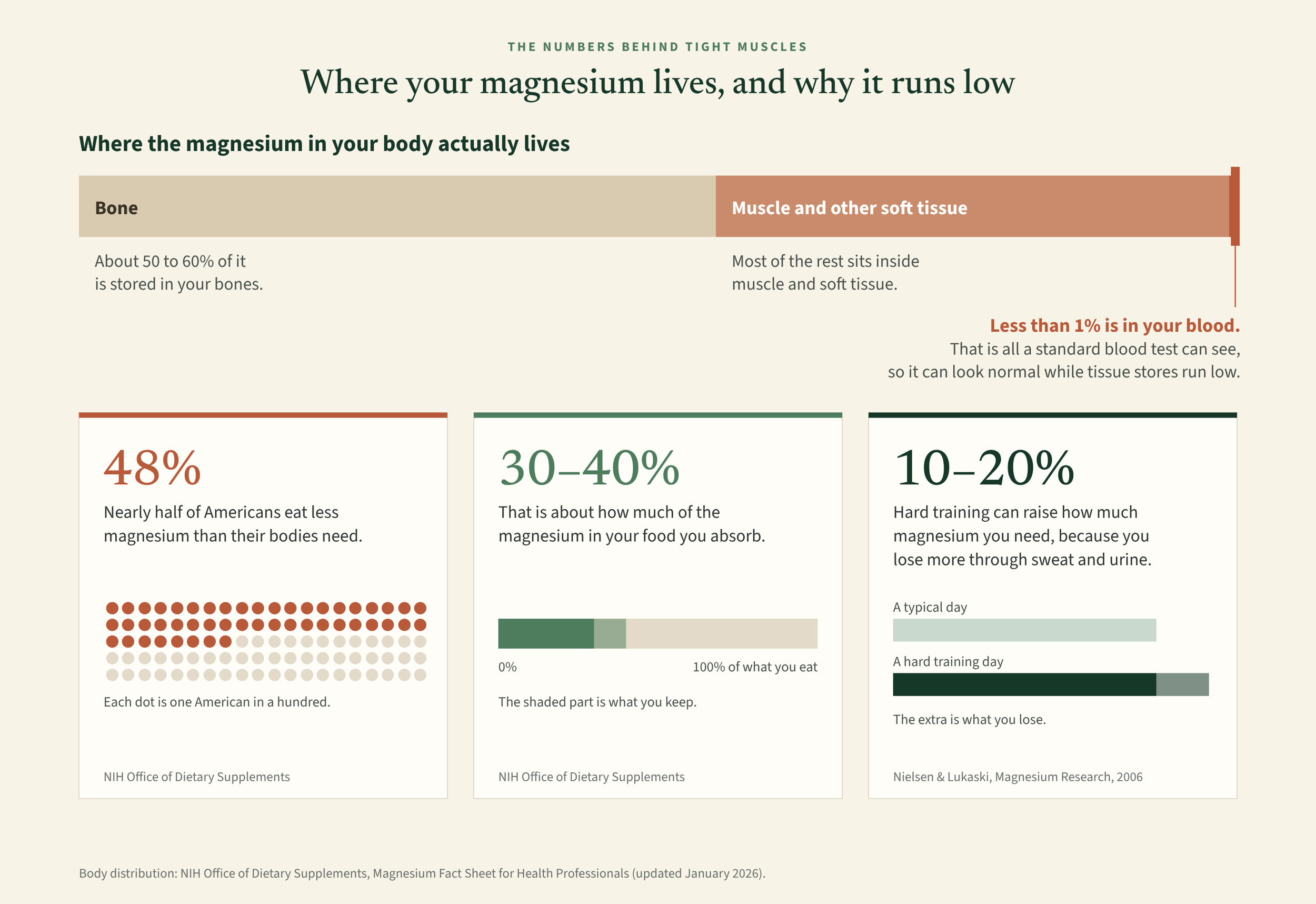
Three numbers that explain a lot of tight muscles
of Americans take in less magnesium from food and drinks than their bodies are estimated to need.
is how much hard training may raise your magnesium needs, because of what you lose in sweat and urine.
of your body’s magnesium is in your blood. The rest is in bone, muscle, and soft tissue, so a normal blood test can miss low stores.
Where we tell our StemWave patients to spray it
We see StemWave patients with all kinds of problems, from stiff necks and sore backs to tight calves, hip pain, and sciatica. Almost all of them go home with the same simple advice from us: use topical magnesium oil on your neck and shoulders, all the way down your back, on your calves, and even on your glutes and the back of your thighs if you are dealing with sciatic pain.
Here is the reason. When an area has been irritated for a while, the muscles around it tighten up to protect it, and over time that guarding becomes its own source of pain. Magnesium oil is an easy way to help those tight, spasmed muscles relax between visits, so the work we do in the office has a better chance to hold.
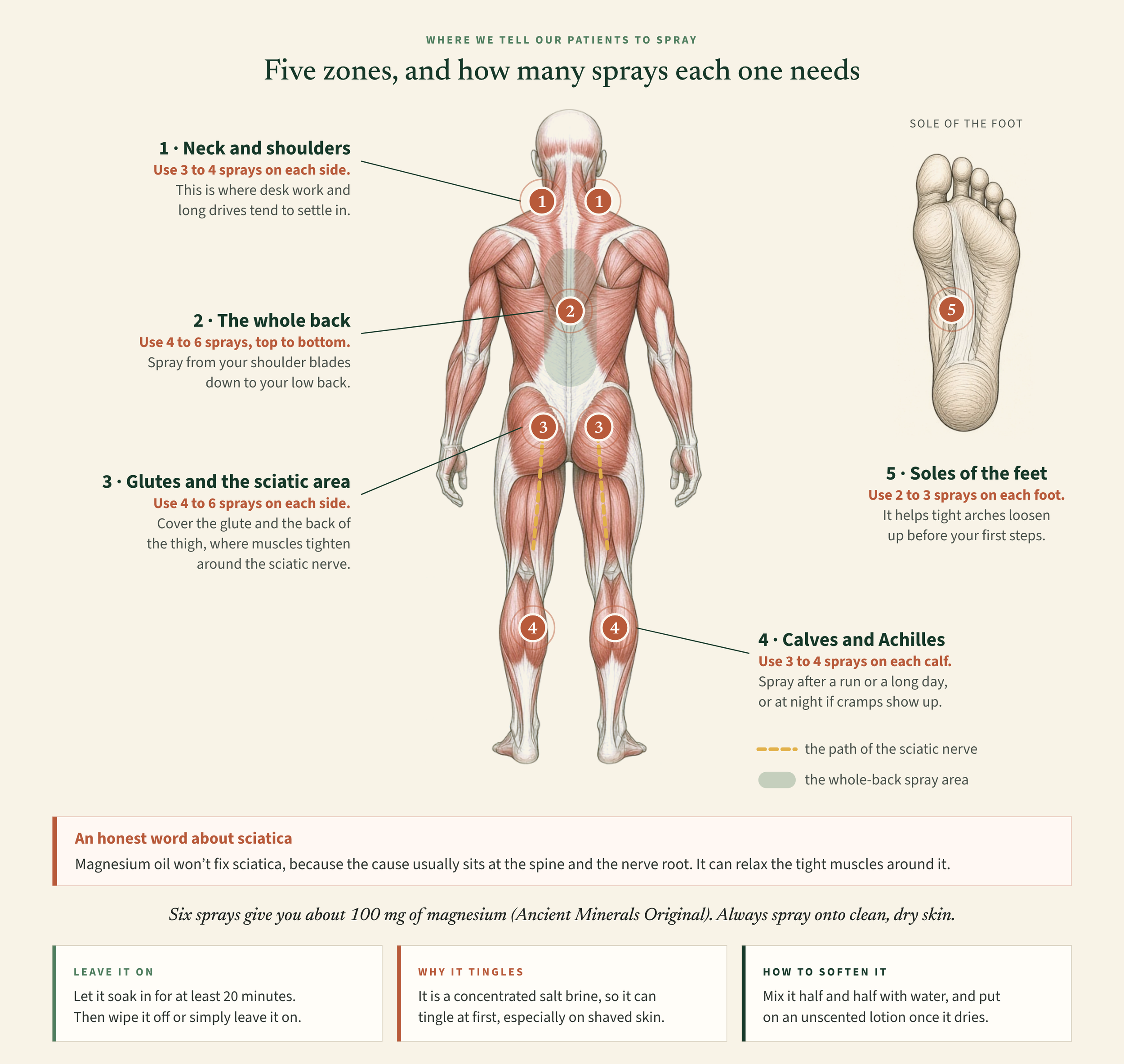
Magnesium oil is not going to cure sciatica. Sciatic pain usually starts where the nerve leaves the spine, and that is something chiropractic care addresses directly by restoring motion to the spine and pelvis. What magnesium oil can do is help relax the tight, spasmed muscles in the glutes and the back of the thigh that pile on around an irritated nerve. That makes it a great thing to do at home alongside your chiropractic adjustments and StemWave sessions.
The routine, step by step
Start with dry skin
Spray after your shower once you have dried off, or any time a muscle feels tight.
Spray and rub it in
Use the spray counts in the chart, then rub it in for about 30 seconds.
Give it 20 minutes
Let it soak in for at least 20 minutes. This is a good time to stretch.
Wipe it or leave it
You can wipe it off, rinse, or leave it on, and add lotion if it tingles.
The recovery spray
After you shower and dry off, spray the muscles you worked the hardest and stretch while it soaks in.
The shoulder reset
Spray your upper shoulders and the back of your neck, then roll your shoulders back and let them drop ten times.
The hip and glute calm-down
Spray the glute and the back of the thigh on the sore side, then lie on your back with your knees bent and breathe slowly for a few minutes.
Why it tingles, and how to make it more comfortable
Magnesium oil isn’t actually an oil. It is a concentrated magnesium chloride brine that just feels slick on the skin. A little tingling or itching is common the first few times you use it, especially on freshly shaved skin or right after a hot shower, and it usually fades as you keep using it. If it bothers you, mix it about half and half with water, put it on skin that has cooled down after your shower, and follow up with an unscented lotion or a little jojoba oil once it dries. Ancient Minerals also makes an Ultra spray with MSM that is designed to tingle less. Keep it off broken skin, your eyes, and mucous membranes, and if you have kidney disease, let us set up your magnesium with you in the office.
Relaxing a muscle is work: calcium tightens it, magnesium helps it let go
Every muscle you have is a bundle of smaller bundles. Your calf is made of fascicles, each fascicle is made of long muscle fibers, and each of those fibers holds thousands of tiny contracting units lined up end to end. When a nerve fires, the fiber releases calcium from a storage area inside it. That calcium uncovers binding sites on the thin actin filaments, and the myosin heads on the thick filaments grab on and pull. That is how the fiber shortens.
Getting the fiber to relax again takes two more steps. Each myosin head needs a fresh molecule of ATP before it can let go, and inside your cells ATP works as a magnesium-ATP pair. Then pumps on the calcium storage area, which also run on magnesium-ATP, pull the calcium back inside so the binding sites close up. Researchers put it simply: both contracting a muscle and relaxing it depend on magnesium.2
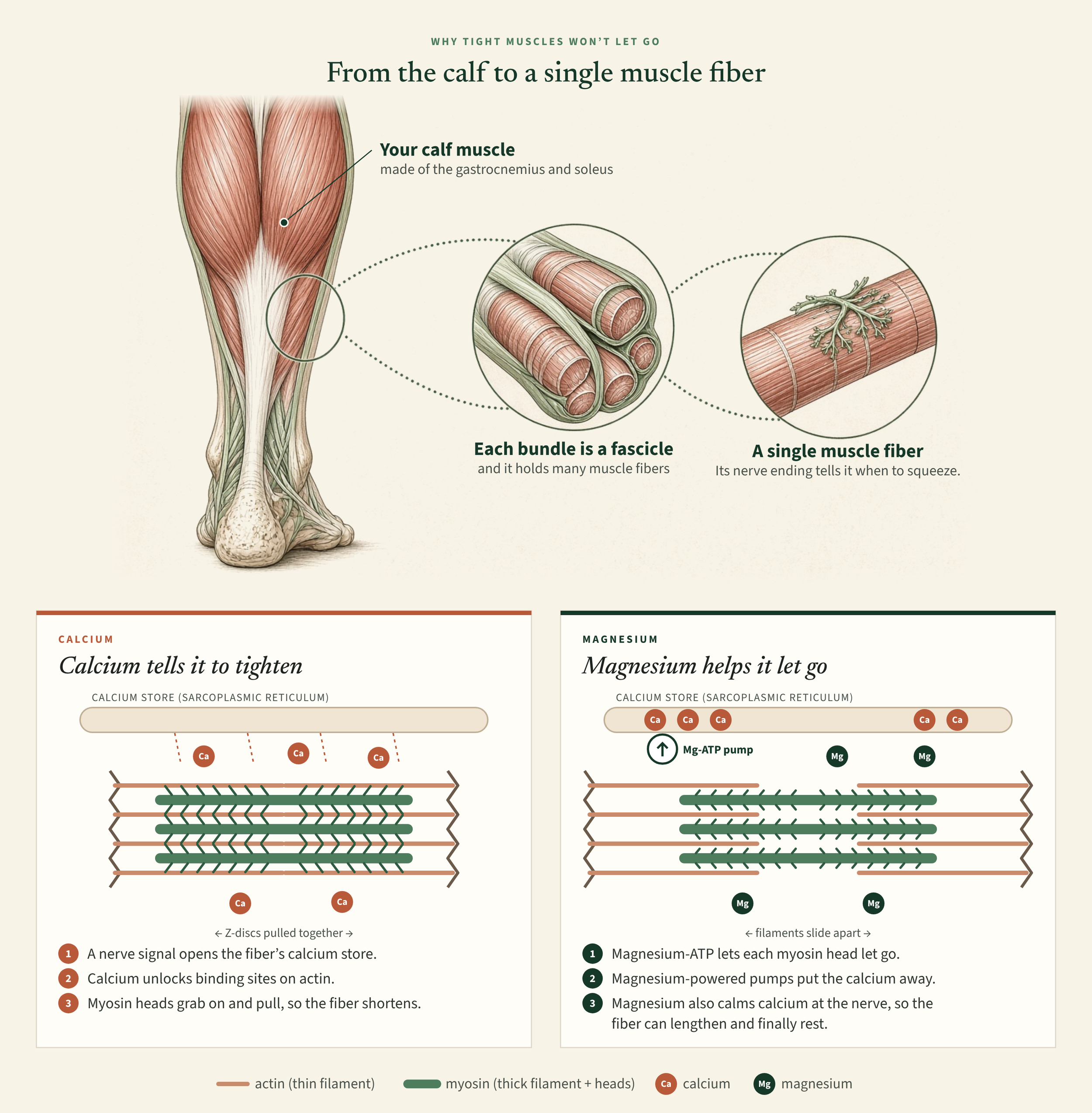
Back in 1984, cardiologists Lloyd Iseri and James French called magnesium “nature’s physiologic calcium blocker,” because it competes with calcium at channels and binding sites throughout the body.3 That is the easiest way to picture a muscle that won’t let go. There is too much “go” signal and not enough “stop.” When the balance tips toward calcium, the fiber stays switched on longer and fires more easily.
Why the nerve keeps the muscle switched on
A muscle only tightens when its nerve tells it to, so tension is never just a muscle problem. Magnesium sits right in the doorway of one of the nervous system’s main “go” channels, the NMDA receptor. When things are calm, a magnesium ion physically plugs that channel and keeps calcium from rushing into the nerve cell. Scientists first showed this magnesium block in a well-known 1984 paper in Nature.4 Magnesium also supports the calming GABA side of the nervous system.5
When magnesium runs low, that doorway isn’t guarded as well. As a deficiency gets worse, the NIH lists numbness, tingling, muscle contractions, and cramps among the signs.1 Our patients usually describe it as feeling wired and tight at the same time.
Stress drains magnesium, and low magnesium makes you react more strongly to stress. A lot of tight shoulders live right inside that loop.
Dr. Holly & Sebastian WaiteA 2020 review in Nutrients took a fresh look at what researchers call the magnesium and stress vicious circle. Physical and emotional stress increase how much magnesium you lose, and low magnesium in turn makes your stress response stronger, so each one feeds the other.6 For many people, the neck and shoulders are the first place they feel it.
What drains your magnesium: sweat, stress, and the modern plate
Most of the people we see aren’t deficient in a way a lab test would flag. They are running a little low, and they are spending magnesium faster than they are putting it back. These numbers show why that is so common.
Sweat and hard training
Hard exercise increases the magnesium you lose in sweat and urine. Researchers estimate it may raise your needs by 10 to 20%, and athletes who cut weight for their sport are especially likely to run low.
Nielsen & Lukaski, Magnes Res, 20067Ongoing stress
Physical and emotional stress appear to increase magnesium loss. Low magnesium then makes the stress response stronger, and the loop keeps tightening.
Pickering et al., Nutrients, 20206A low-magnesium plate
Nearly half of Americans eat less magnesium than they need. Refined grains and processed foods carry very little of it, and your body only absorbs about 30 to 40% of what you do eat.
NIH ODS1Common medications
Diuretics and acid reducers called proton pump inhibitors can lower your magnesium over time. If you take either one, please mention it at your visit.
NIH ODS1 · de Baaij et al., Physiol Rev, 20158What the research honestly says about a spray
We like topical magnesium chloride for a practical reason. You can put it right on the muscle that is tight, and it skips your stomach, which matters because oral magnesium oxide and citrate are known for sending people to the bathroom. Here is what the studies show about how much gets through the skin, told as carefully as the research allows.
Why we use Ancient Minerals: the Zechstein difference
Magnesium chloride is everywhere, and it is not all the same. We recommend this brand for one main reason: where the magnesium comes from, and how cleanly it makes it into the bottle.
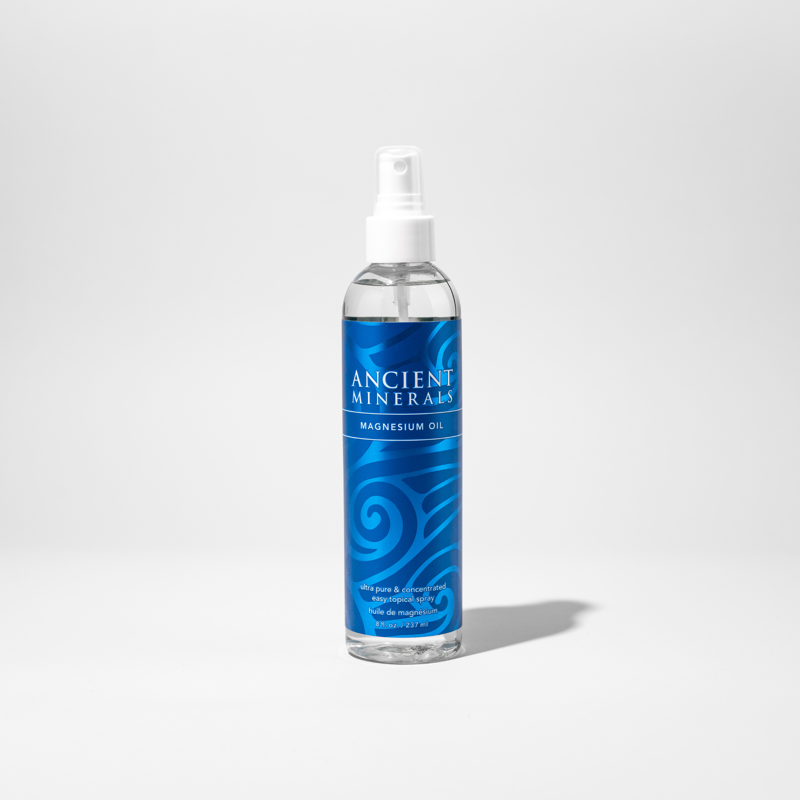
Ancient Minerals Magnesium Oil, 8 oz
It has just two ingredients: water and Genuine Zechstein magnesium chloride, along with its naturally occurring trace minerals. There is no fragrance, no dye, and no filler.14
It comes from an ancient, sealed source
Zechstein magnesium comes from the floor of a sea that dried up about 250 million years ago. Today it sits 1,600 to 2,000 meters, more than a mile, under the Netherlands.15
It is protected from modern pollution
Because it has been sealed under rock since long before factories existed, it is out of reach of the microplastics and heavy metals that can end up in salt taken from today’s oceans.15
The ingredient list is short
The Original spray lists water and magnesium chloride, so nothing is covering anything up or watering down what you paid for.14
What to look for on any bottle
Look for a named source like Genuine Zechstein, a short ingredient list, and the amount of magnesium per spray. If a label just says “ocean minerals” with no testing, we would pass.
The rest of the lineup we use
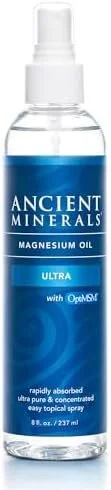
Magnesium Oil Ultra with MSM, 8 oz
It is the same Zechstein magnesium with MSM added, and it is made to tingle less. This is our pick for sensitive skin.
View on Amazon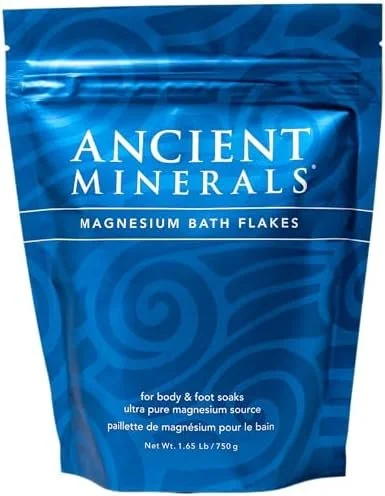
Magnesium Bath Flakes, 1.65 lb
We use these for foot soaks after a long shift and for a full bath after a race or a big day of yard work.
View on Amazon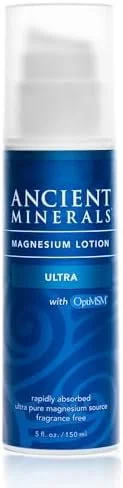
Magnesium Lotion Ultra, 5 oz
Each pump has about 20 mg of magnesium in a moisturizing base, and it is easy to work into your shoulders and calves.
View on Amazon
Oral magnesium glycinate
It is gentle on the stomach, and we carry the forms we trust in our Fullscript dispensary.
Open our Fullscript storeAs an Amazon Associate, we earn from qualifying purchases.
Should you make it yourself or buy it?
You can make magnesium oil at home from the same Zechstein flakes. Here is how the two options compare.
Making it from flakes
Dissolve 1/2 cup of flakes in 1/2 cup of hot distilled water- It costs less per ounce once you own the flakes.
- You control the strength, so you can start weaker if it tingles.
- Use distilled water and a clean glass spray bottle.
- Equal parts flakes and water makes a somewhat milder brine than the bottled spray, so each spray is a little less predictable.
Buying the spray
Ancient Minerals Original or Ultra- You know the dose: about 100 mg in six sprays.
- It is sealed and consistent from bottle to bottle.
- It fits easily in a gym bag or a desk drawer.
- It costs more per ounce than making your own.
When the same muscle keeps coming back
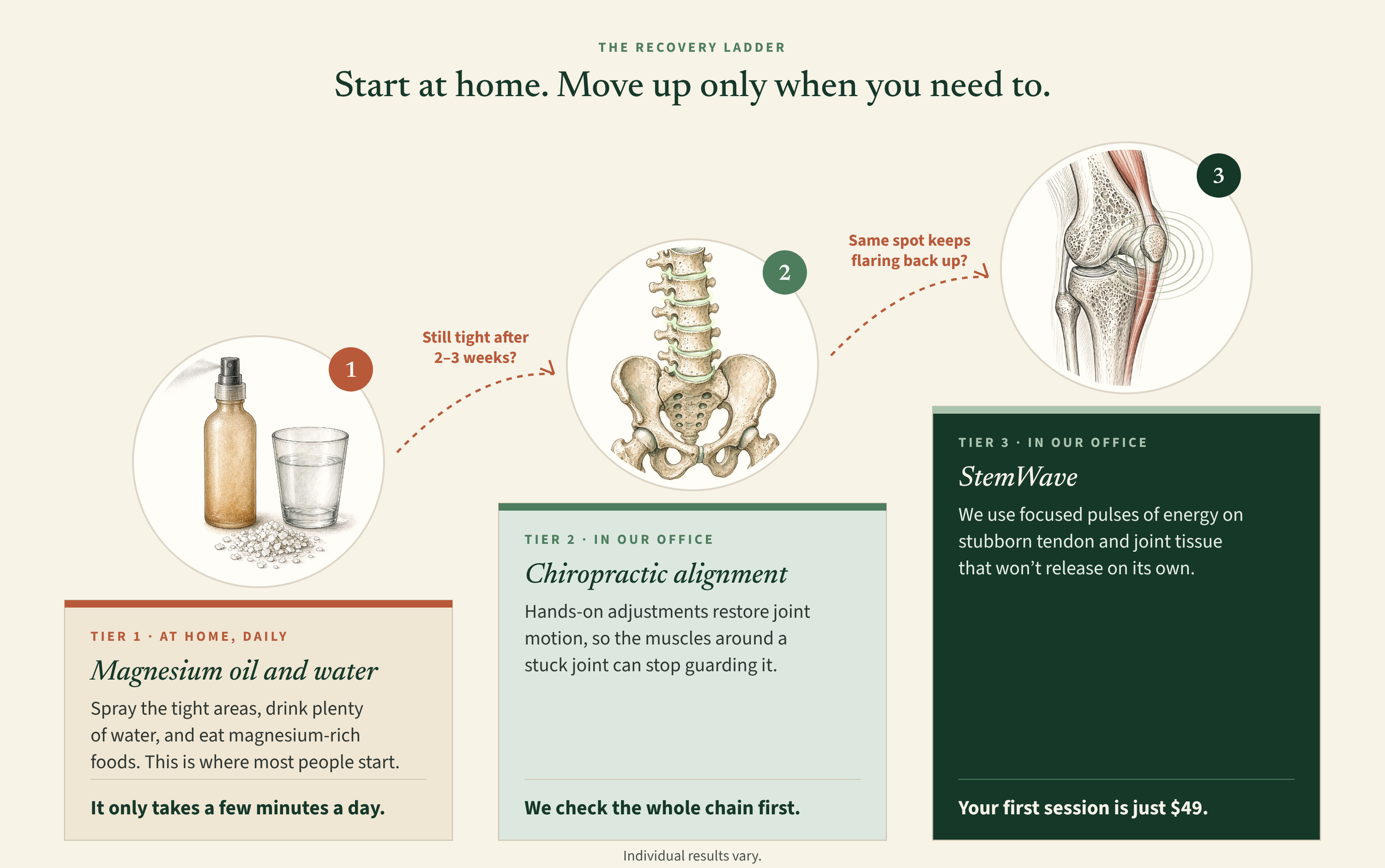
Magnesium oil is something you can use every day, and for most everyday tightness it is enough. But some tension isn’t really about minerals. When a joint stops moving well, the muscles around it tighten up to protect it, and a tendon that has been overloaded for months can stay irritated no matter how much magnesium you spray on it. Sciatica is the classic example. That is when it is time to move up the ladder.
Chiropractic care and StemWave for tension that won’t let go
We start by figuring out why the muscle is guarding in the first place. We look at how the joints above and below it are moving, from your feet and ankles up through your hips, pelvis, and spine, and then we use gentle chiropractic adjustments to bring back motion where things have stiffened. With sciatica, that means working on the spine and pelvis where the nerve starts. When a joint moves the way it should, the muscles around it can usually stop bracing.
For deeper, stubborn tissue around the Achilles, heel, knee, hip, or shoulder that keeps flaring up even after you have done your part at home, we add StemWave. It delivers focused pulses of energy to the tendon and joint tissue that won’t settle down on its own. Between visits, magnesium oil on the tight muscles around the area is the easiest thing you can do to keep the progress going.

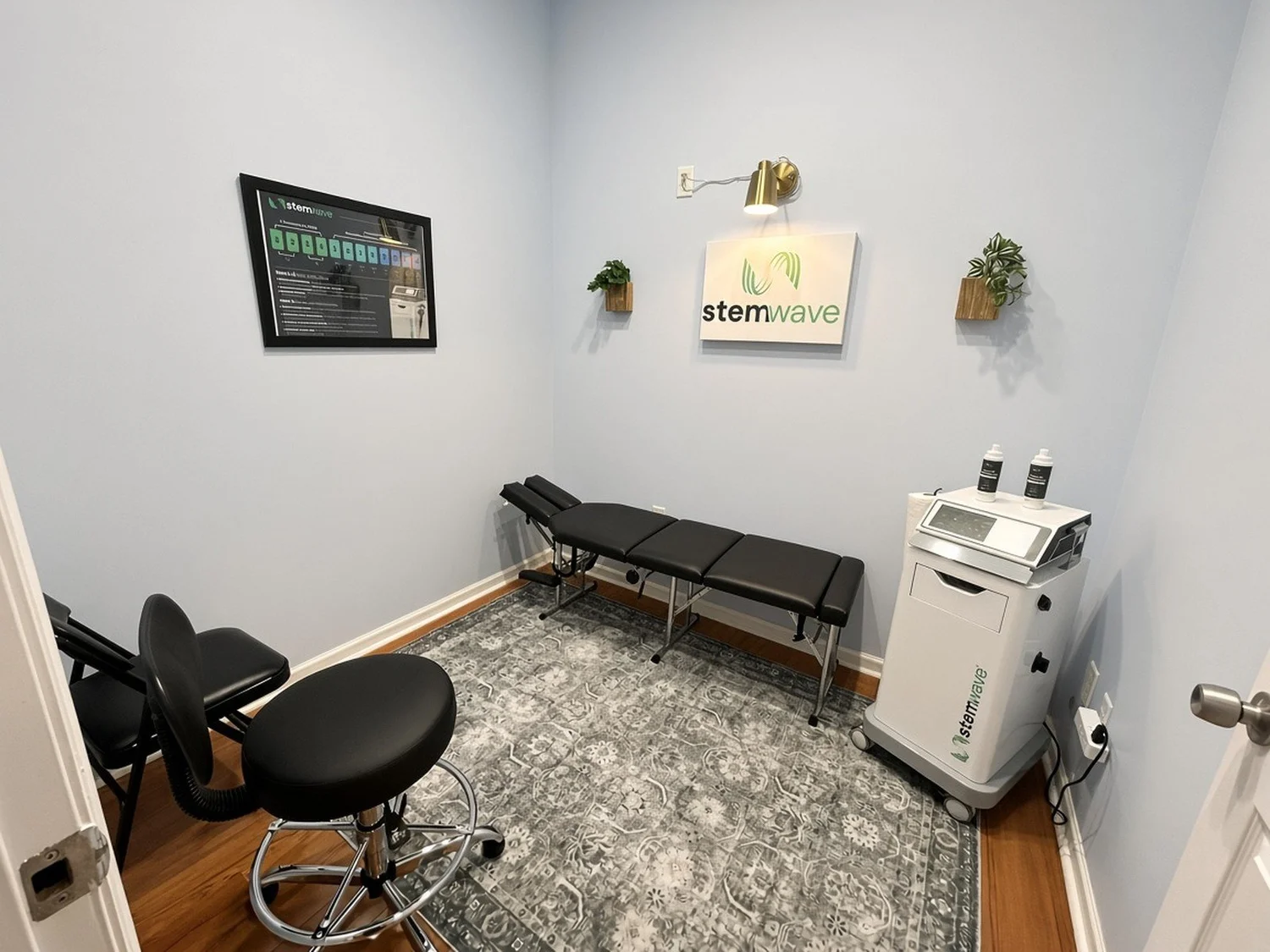
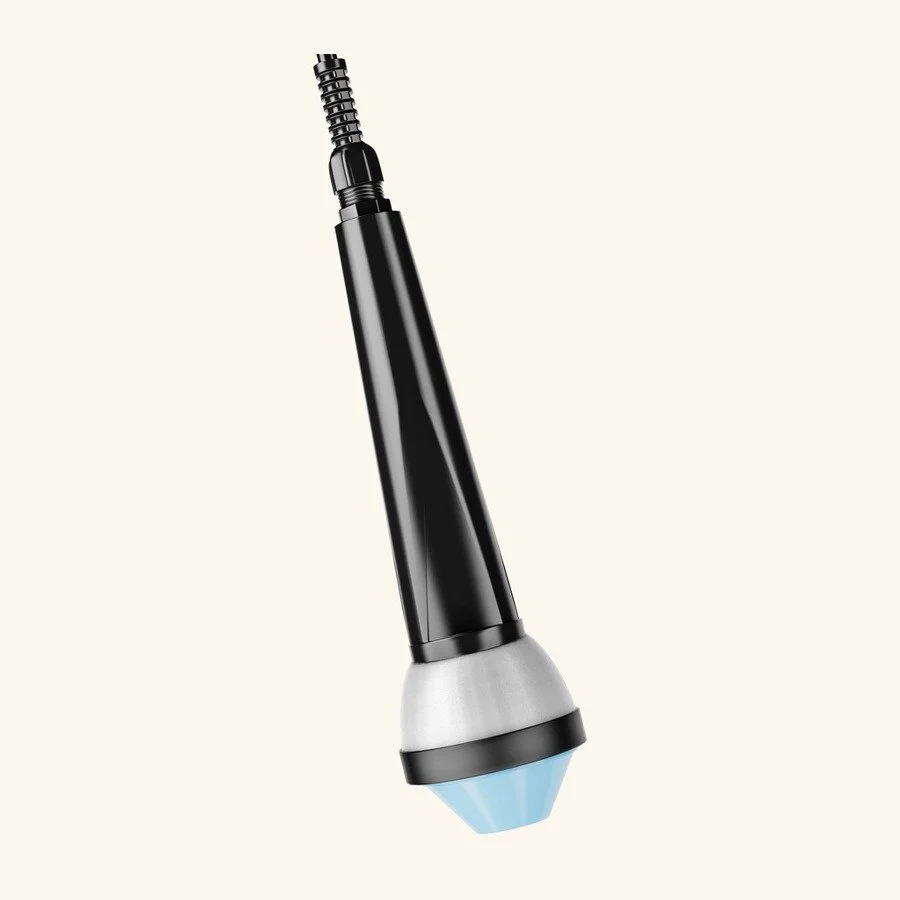
Your StemWave intro session is $49 for new patients, so you can feel how that stubborn calf, heel, knee, hip, or shoulder responds before you commit to anything more.Individual results vary.
Magnesium oil for muscles, answered
Does magnesium oil work for muscle cramps?
It helps the most when low magnesium is part of the picture, like when you sweat a lot, train hard, live with a lot of stress, or don’t eat many magnesium-rich foods. Studies show magnesium chloride does cross the skin. That said, a Cochrane review found that typical night cramps in older adults didn’t respond to oral magnesium, so when cramps keep coming back, we also look at your hydration, your training, and how your joints are moving.
Is it better before or after a workout?
We like it best after. Once you have showered and dried off, spray the muscles you worked the hardest and leave it on for 20 minutes. On heavy training days, a second round on your calves before bed is a good habit.
Why does it tingle, and is that a bad sign?
The tingle comes from a concentrated salt brine sitting on your skin, and it is very common at first. It doesn’t mean anything is wrong. You can mix it with water, put it on dry skin, follow it with lotion, or switch to the Ultra formula with MSM.
Does a spray replace oral magnesium?
No, it doesn’t. The spray takes care of the tight spot without upsetting your stomach. Food and a well-absorbed oral glycinate are how we build up your whole-body levels, and since the research on topical magnesium is promising but still small, we use both.
How is this different from your sleep article?
Our sleep guide is about using magnesium oil at night to help you wind down and stay asleep. This guide is about tight muscles, cramps, nerve tension, and recovery during the day. A lot of people use the same bottle for both.
Will magnesium oil help my sciatica?
It won’t cure it, and we want to be honest about that. Sciatica usually comes from irritation where the nerve leaves your spine, and chiropractic care is what addresses that. What magnesium oil can do is help the tight, spasmed muscles in your glutes and the back of your thigh relax, which is why we recommend it to our patients as a great complement to their adjustments and StemWave sessions.
When should I come in instead?
If the same muscle is still tight after two to three weeks of daily use, or a heel, Achilles, knee, hip, or shoulder keeps flaring up in the same spot, the cause is most likely a joint or a tendon. That is when chiropractic care and our $49 StemWave intro session come in. Individual results vary.



- National Institutes of Health, Office of Dietary Supplements. Magnesium: Fact Sheet for Health Professionals. Updated January 6, 2026.
- Jahnen-Dechent W, Ketteler M. Magnesium basics. Clin Kidney J. 2012;5(Suppl 1):i3-i14. PMID 26069819.
- Iseri LT, French JH. Magnesium: nature’s physiologic calcium blocker. Am Heart J. 1984;108(1):188-193. PMID 6375330.
- Nowak L, Bregestovski P, Ascher P, Herbet A, Prochiantz A. Magnesium gates glutamate-activated channels in mouse central neurones. Nature. 1984;307(5950):462-465. PMID 6320006.
- Kirkland AE, Sarlo GL, Holton KF. The role of magnesium in neurological disorders. Nutrients. 2018;10(6):730. PMID 29882776.
- Pickering G, Mazur A, Trousselard M, et al. Magnesium status and stress: the vicious circle concept revisited. Nutrients. 2020;12(12):3672. PMID 33260549.
- Nielsen FH, Lukaski HC. Update on the relationship between magnesium and exercise. Magnes Res. 2006;19(3):180-189. PMID 17172008.
- de Baaij JH, Hoenderop JG, Bindels RJ. Magnesium in man: implications for health and disease. Physiol Rev. 2015;95(1):1-46. PMID 25540137.
- Chandrasekaran NC, Sanchez WY, Mohammed YH, et al. Permeation of topically applied magnesium ions through human skin is facilitated by hair follicles. Magnes Res. 2016;29(2):35-42. PMID 27624531.
- Kass L, Rosanoff A, Tanner A, et al. Effect of transdermal magnesium cream on serum and urinary magnesium levels in humans: a pilot study. PLoS One. 2017;12(4):e0174817. PMID 28403154.
- Watkins K, Josling PD. A pilot study to determine the impact of transdermal magnesium treatment on serum levels and whole body CaMg ratios. Eur J Nutraceutical Res. 2010.
- Gröber U, Werner T, Vormann J, Kisters K. Myth or reality: transdermal magnesium? Nutrients. 2017;9(8):813. PMID 28788060.
- Garrison SR, Korownyk CS, Kolber MR, et al. Magnesium for skeletal muscle cramps. Cochrane Database Syst Rev. 2020;9:CD009402. PMID 32956536.
- Ancient Minerals. Magnesium Oil: ingredients, 100 mg elemental magnesium per 6 sprays, directions. ancient-minerals.com/products/magnesium-oil
- Zechstein Inside. Our source: Veendam, the Netherlands; 1,600 to 2,000 meters deep; about 250 million years old. zechsteininside.com